
Suki Liu
About
Resume


Georgia Institute of Technology
This was a student project exploring service design. Working with a teammate Kuo-Wei Lee over 3 months, we designed an online comparison tool to help consumers make sustainable purchasing decisions when buying electronics. The project was recognized with the 2024 iF Design Award.
Project & Timeline
•
UX Designer
•
September 2023 - December 2023
Tools
User Research / Circular Economy Framework / Personas / Journey Mapping / Service Design /TheyDo / Prototyping / Usability Testing
The Challenge
Electronics are one of the fastest growing waste streams in the world. While 41.2% of consumers are willing to recycle their used devices and 78% pay attention to where recycled materials go, only 40% of electronics are actually being recycled. The gap between intention and action is not a lack of awareness. It is a lack of accessible, comparable information at the moment that matters most — the purchase decision.
We chose this topic because sustainability in electronics purchasing is a problem that affects everyone, yet no accessible tool existed to help everyday consumers act on their environmental values at the point of sale.
The core question was: How might we guide people to effectively research and prioritize sustainable criteria when making their purchase decision?

Final Design
Research & Scope
Circular Economy Framework
The project was grounded in the principles of the circular economy, an economic model that reduces waste and maximizes resource utilization by keeping materials and products in circulation for as long as possible. Three principles shaped the research direction.
01 Eliminate waste and pollution
What if waste were never created in the first place?
02 Circulate products and materials
What if we could build an economy that uses things rather than uses them up?
03 Regenerate nature
What if design could not only protect but actively improve the environment?


Circular Economy Term Definition & Opportuniies
These principles defined the scope. Rather than designing a recycling tool, the goal became helping consumers make better decisions before purchase — the moment with the highest leverage in the product lifecycle.
What We Found
Research into consumer electronics buying behavior revealed a consistent pattern. Consumers cared about sustainability but had no practical way to act on that concern at the point of purchase. Three pain points emerged.
Information is scattered
Sustainability data exists but is spread across manufacturer websites, third-party certifications, and review platforms. Consumers have no single place to research and compare.
Sustainability criteria are unclear
Most consumers do not know what makes an electronic product sustainable or how to evaluate competing brand claims.
Trade-in and refurbishment options are invisible
Even motivated consumers have no easy way to find or evaluate end-of-life options at the point of purchase.
The insight was clear: the problem was not awareness. It was access and clarity at the right moment.
Design Exploration
Personas
Three personas were developed based on research into consumer electronics buying behavior and attitudes toward sustainability, representing the range of users the tool needed to serve.

Personas
AS-IS Journey Map
The current state journey map revealed exactly where the gap between intention and action occurred. Consumers who wanted to make sustainable choices were failing not because they did not care, but because the information they needed was too fragmented and too hard to compare at the moment of decision.
drag me!
Interactive prototype in Figma (you can press "R" to refresh the prototype)
The Solution
The solution is an online eco-friendly product comparison tool for electronic consumers, developed based on EPEAT — the Electronic Product Environmental Assessment Tool, the premier global ecolabel for electronics and technology products.
The tool guides users through four stages of the decision-making process.
Learning
Gather information on product's sustainability features, practices, and compare with competitors.
Comparing
Compare the sustainability of different electronic products based on prices and environmental impact, helping them make informed choices.
Deciding
Make the right choice based on the previous research.
Refurbishing/Trade-in
Evaluate trade-in or refurbish options and share eco-friendly refurbish process to the community.
TO-BE Journey Map
The redesigned journey map shows how the tool removes friction at each stage of the decision-making process, from initial research through purchase and post-purchase trade-in.
drag me!
Interactive prototype in Figma (you can press "R" to refresh the prototype)
The Design
With the research foundations in place, the design focused on making sustainability information accessible, comparable, and actionable within a single tool.

Final Design
Learn
Users can gather sustainability information on any electronic product and compare it directly with competitor products, all in one place.
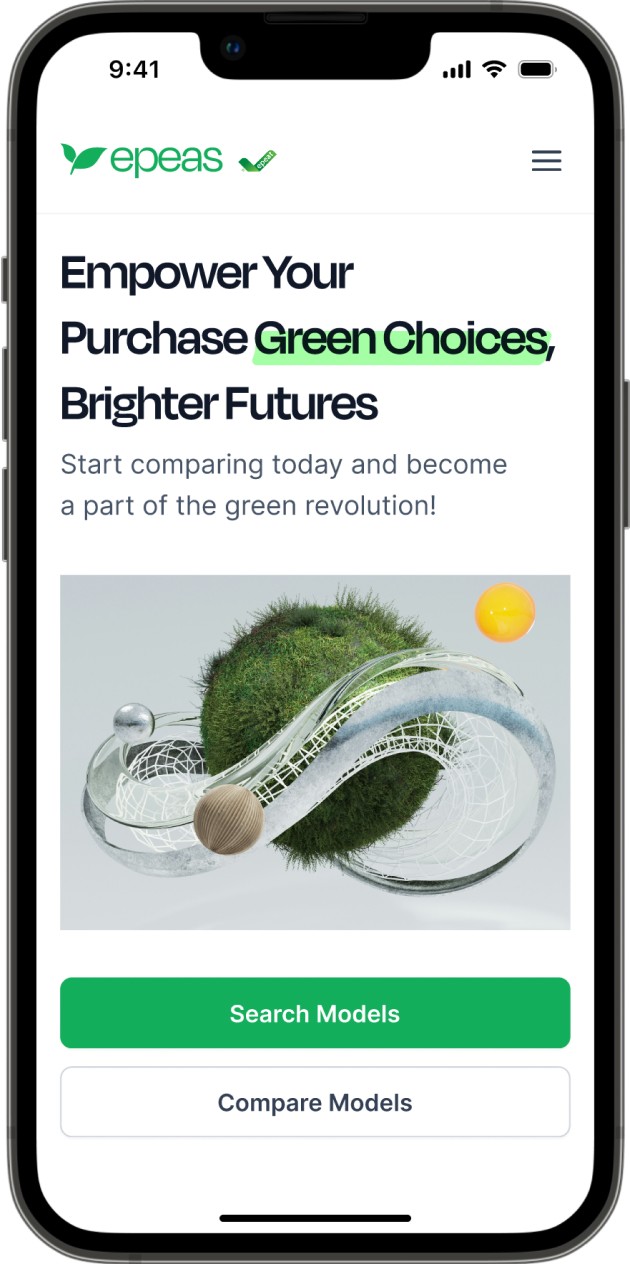


Learn Screen
Evaluate
Users can assess electronics side by side on eco-friendly attributes and cost, giving them a clear picture of the trade-offs between price and environmental impact.
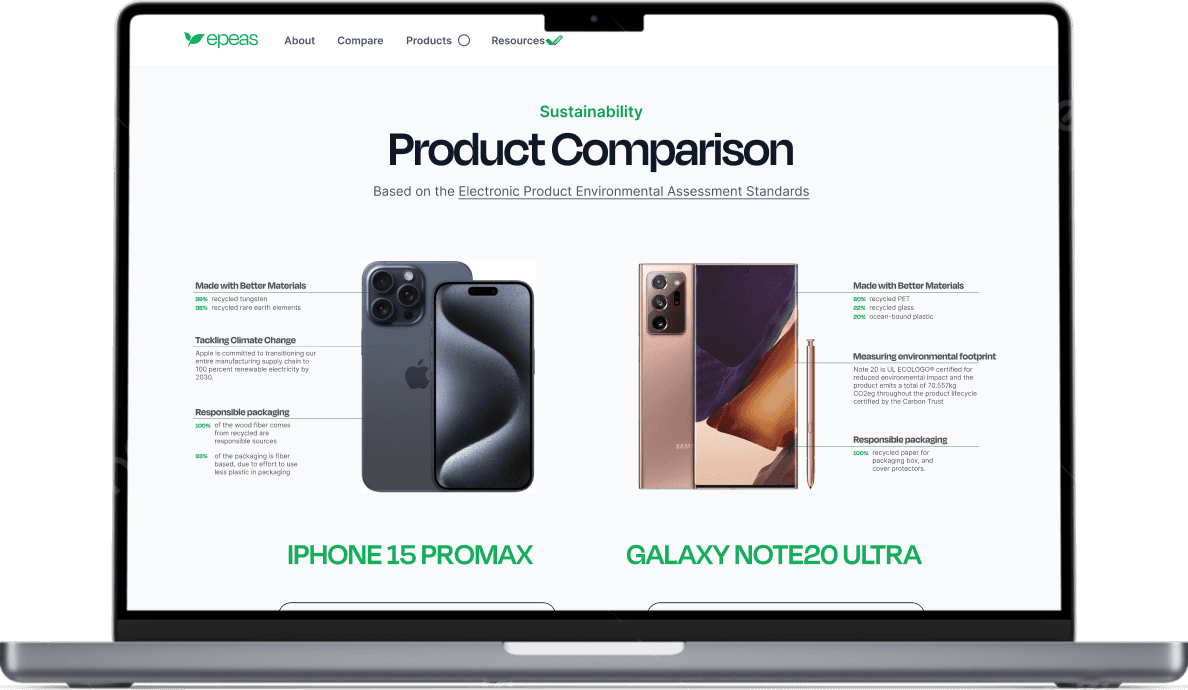
Evaluate Screen
Decide
A clear recommendation is surfaced based on the user's priorities, removing the final barrier between research and action.

Decide Screen
Service Design & Physical Touchpoints
A key insight from the validation session was that the digital tool alone was not enough. Users needed to encounter sustainability information at the physical moment of purchase, not only online.

Physical Touchpoints
The service design extended the experience into two physical touch-points.
In-store
Within retail stores such as Best Buy, Target, and carrier stores, posters and interactive kiosks feature QR codes allowing users to access product sustainability information and the comparison tool directly from the shelf — at the exact moment they are making a decision.
Unboxing
The unboxing experience includes an informative insert giving users the choice to stay updated on new eco-friendly products or explore refurbishment and trade-in options, reaching them at the moment they are most engaged with the product.
Design Language
We then built a design language that translates EPEAS's values into one consistent system. The identity sits where three values meet, Renewable, Eco-Conscious, and Impactful, expressed as a single growing leaf that stands for the growth and life that come from choosing better.
Green anchors the palette as the color most tied to growth, sustainability, and trust, with deeper tones carrying structure and brighter accents adding energy and youthfulness. Degular Display and Inter keep the type confident and readable, a custom icon set turns environmental criteria into simple symbols, and natural textures keep the experience rooted in the real world it advocates for.

Branding & Design system
Next Mission
Our vision is to establish a vibrant community that appreciates the significance of eco-friendly choices and actively engages in advocating for a more sustainable and conscientious lifestyle through collective insights and motivations.
Reflection & learnings
This was an early project that taught me how to translate a complex framework into something everyday consumers could use without prior knowledge. Every design decision had to balance information depth with accessibility, ensuring the tool was useful for both casual buyers and environmentally conscious researchers.
The biggest lesson was that sustainability design is not about raising awareness. Consumers already care. The real challenge is removing the friction between intention and action: giving people the right information, in the right format, at the right moment. Extending the design beyond the screen into physical retail touchpoints was the most important decision we made on this project, and the one most recognized by the iF Design Award.


